There are action films that entertain you.
And then there are films like BAKI HANMA (2026) — movies that feel like they’re punching directly through your chest.
The moment this trailer begins, it becomes painfully obvious that this isn’t trying to be a “normal” martial arts movie. It’s a blood-soaked opera of violence, masculinity, obsession, and raw physical domination. Every frame screams chaos. Every impact feels illegal. And somehow, against all logic, it works.
This is not subtle cinema.
It’s war inside a cage.
What This Film Is Really About
At its core, BAKI HANMA (2026) is not simply about fighting. It’s about inheritance. Legacy. Fear. The terrifying burden of trying to surpass a monster who may not even be human anymore.
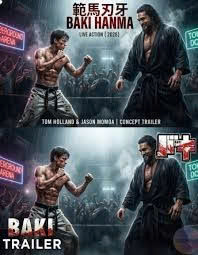
Mackenyu Arata steps into the role of Baki with a quiet intensity that immediately separates him from traditional action heroes. He doesn’t fight because he enjoys violence. He fights because violence is the only language his world understands.
And standing over that world like a demonic god is Jason Momoa’s terrifying interpretation of Yujiro Hanma — “The Ogre.”
His presence alone changes the atmosphere of the film.
Every scene involving Yujiro feels dangerous. Not cinematic dangerous. Real dangerous. The kind where characters stop breathing when he enters the room.
The underground prison arena becomes more than a setting. It becomes a psychological furnace where broken men attempt to prove they deserve to survive. Fighters crush bones, rip through defenses, and throw themselves into combat with animalistic desperation because losing here means something worse than death:
Humiliation.
That emotional layer is what elevates the film beyond pure spectacle.

Performance & Characters
Mackenyu Arata as Baki
Mackenyu delivers a physically demanding performance, but the real surprise is how emotionally restrained he plays the character. Beneath the shredded physique and explosive combat choreography is a young man desperately trying to escape the shadow of his father.
He almost disappears beneath the brutality at times.
But then the film slows down for a split second — a stare, a breath, a trembling hand — and suddenly you understand the tragedy underneath the muscles.
That’s where the performance truly lands.
Jason Momoa as Yujiro Hanma
Jason Momoa was born to play this role.
Not because he’s physically imposing — though he absolutely is — but because he understands how to weaponize charisma. His Yujiro isn’t just strong. He enjoys being feared. He walks through the film like an apex predator who already knows the outcome.
And honestly?
That confidence becomes horrifying.
There’s a sequence teased in the trailer where Yujiro silently watches the arena from above, glowing red eyes burning through the darkness like some ancient war deity. It’s absurd. Over-the-top. Completely insane.
And unforgettable.

The Supporting Fighters
The supporting cast understands exactly what kind of universe this is. Nobody underplays their role. Fighters snarl, roar, bleed, and crash into one another with comic-book intensity, yet the commitment is so complete that the madness becomes believable.
That balance is difficult to achieve.
Most live-action anime adaptations fail because they’re embarrassed by their source material. BAKI HANMA embraces its insanity with total confidence.
Visuals, Tone, and Direction
This movie looks like someone injected pure testosterone into a lightning storm.
The direction leans heavily into hyper-stylized brutality: slow-motion muscle contractions, sweat flying through prison floodlights, bones cracking like gunshots, and bodies slamming into concrete hard enough to shake the camera itself.
But beneath the spectacle is surprisingly disciplined visual storytelling.
- The prison arena feels claustrophobic and hellish.
- The lighting emphasizes physical intimidation.
- The camera movements mimic predatory behavior.
- The sound design turns every punch into psychological trauma.
One of the film’s smartest choices is refusing to sanitize violence. Hits look painful. Exhaustion matters. Fighters stagger, gasp for oxygen, and drag themselves forward through sheer rage.
That realism inside such an exaggerated universe creates an addictive tension.
It almost becomes mythological.
“Every man in this arena is trying to prove he deserves to exist.”
That may be the film’s hidden emotional thesis.

What Works — And What Doesn’t
What Works
- Jason Momoa’s terrifying screen presence
- Faithful adaptation of Baki’s chaotic energy
- Visceral fight choreography with real impact
- Stylized cinematography that amplifies tension
- Emotional father-son conflict beneath the violence
What Doesn’t
- Some viewers may find the hyper-masculine intensity exhausting
- The exaggerated anatomy and anime-style physics will absolutely divide audiences
- Certain dramatic moments risk collapsing under the film’s relentless aggression
And yet…
It almost fails because of those excesses.
But then it surprises you.
Because the film understands something most action movies forget:
Violence is only memorable when emotion survives underneath it.
Final Verdict
BAKI HANMA (2026) is loud, savage, excessive, ridiculous, and undeniably thrilling. It transforms the absurdity of the original anime into a cinematic experience that feels primal and strangely hypnotic.
This isn’t prestige filmmaking.
It’s gladiatorial madness fueled by rage, trauma, testosterone, and raw spectacle.
But in an era where so many action films feel weightless and forgettable, BAKI HANMA hits like a concrete wall to the ribs.
You feel it.
And you remember it.
Rating: 9.5/10
A hyper-violent martial arts spectacle that turns every punch into mythology and every fighter into a desperate soul clawing for survival.