Franchises built on nostalgia rarely evolve without losing what made them iconic in the first place. Most reboots either become empty fan service or bury their original message beneath endless CGI spectacle.
But Captain Planet (2026) appears to be doing something far more dangerous.
And honestly?
Nobody expected this franchise to return with this much rage.
What was once a colorful environmental cartoon has transformed into a dystopian eco-thriller that feels disturbingly close to reality. Rising oceans, poisoned skies, collapsing ecosystems, endless megastorms — this version of Earth no longer looks like science fiction.
It looks like a warning.
What This Film Is Really About
On the surface, Captain Planet (2026) delivers massive blockbuster spectacle: catastrophic climate disasters, colossal elemental battles, futuristic corporate empires, and nature itself unleashed as a weapon.
But beneath the destruction lies something darker.
This is a story about consequences.
Humanity ignored every warning. Governments failed. Corporations consumed the planet for profit while entire ecosystems collapsed in silence. Now the Earth is no longer asking humanity to change.
It is fighting back.
That shift completely reinvents the mythology.

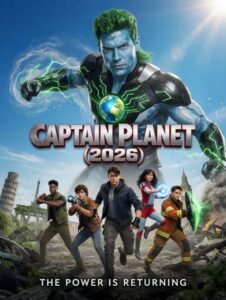
Captain Planet is no longer portrayed as a cheerful protector arriving to save humanity from pollution. This version emerges almost like an ancient force awakened by planetary suffering itself — emotionally distant, terrifyingly powerful, and driven by the fury of a dying world.
And that makes him infinitely more compelling.
“The planet is no longer trying to protect us. It’s deciding whether we deserve to survive.”
That idea hangs over every frame of the teaser.
The New Planeteers Bring Real Emotional Weight
One of the film’s smartest decisions is grounding the story through a new generation of Planeteers.
Each comes from a region devastated by environmental collapse:
A survivor of coastal flooding
A refugee from wildfire-ravaged forests
A child raised in toxic industrial wastelands
A young activist radicalized by government inaction
A healer struggling to preserve what little life remains
They are not idealistic cartoon heroes.
They are traumatized survivors carrying anger, guilt, grief, and conflicting beliefs about whether humanity is even worth saving anymore.
![Netflix is indeed bringing Captain Planet and the Planeteers back as a live-action series [33]. The project is currently in early development at the streaming service. There is no official release date](data:image/svg+xml;base64,PHN2ZyB4bWxucz0iaHR0cDovL3d3dy53My5vcmcvMjAwMC9zdmciIHdpZHRoPSIyMDYiIGhlaWdodD0iMjQ0IiB2aWV3Qm94PSIwIDAgMjA2IDI0NCI+PHJlY3Qgd2lkdGg9IjEwMCUiIGhlaWdodD0iMTAwJSIgc3R5bGU9ImZpbGw6I2NmZDRkYjtmaWxsLW9wYWNpdHk6IDAuMTsiLz48L3N2Zz4=)
That emotional tension gives the film surprising depth.
Instead of functioning like simple side characters, the Planeteers appear to represent different responses to ecological collapse — hope, rage, denial, revenge, sacrifice.
And Captain Planet himself may be the most frightening reflection of all.
Visuals, Tone, and Scale
Visually, this film looks absolutely massive.
The teaser showcases drowned megacities swallowed by endless storms, burning jungles stretching beyond the horizon, frozen oceans splitting apart beneath collapsing ice shelves, and gigantic extraction machines ripping the Earth open like mechanical predators.
Every image feels drenched in environmental horror.
The cinematography leans heavily into dark sci-fi realism rather than colorful comic-book fantasy. Smoke-filled skies, toxic rain, collapsing coastlines, and glowing energy storms create an atmosphere that feels hauntingly believable.
And unlike many modern superhero films overloaded with weightless visuals, Captain Planet (2026) appears to understand restraint.
The silence matters.
The destruction feels personal.

Nature itself becomes part of the storytelling.
Even the action scenes seem driven more by emotional stakes than empty spectacle.
What Works — And What Raises Questions
What Works
A surprisingly mature reinvention of the franchise
A darker, emotionally grounded Captain Planet
Powerful environmental imagery
Large-scale dystopian worldbuilding
Thematically relevant social commentary
A visually stunning eco-apocalypse atmosphere
What Raises Questions
The film’s darker tone may divide longtime fans who remember the lighter animated series. Some audiences may also find the environmental themes overwhelmingly bleak if the story leans too heavily into despair.
There’s also the challenge every modern reboot faces:
Can the emotional storytelling remain as strong as the spectacle?
Because visually, this already looks enormous.
But then the teaser reveals another collapsing city.
Another elemental catastrophe.
Another glimpse of Captain Planet standing inside a hurricane like an unstoppable force of judgment.
And suddenly the film stops feeling like a reboot.
It starts feeling like prophecy.
Final Verdict
Captain Planet (2026) could have easily become another shallow nostalgia project designed to recycle a recognizable name for modern audiences.

Instead, it appears to evolve into something far more ambitious.
A dystopian environmental epic.
A superhero story fueled by grief, fury, and ecological collapse.
A science-fiction warning disguised as blockbuster entertainment.
Most importantly, it understands something modern audiences desperately crave:
Superhero stories only matter when the stakes feel real.
And in a world already facing climate disasters, collapsing ecosystems, and rising global anxiety, Captain Planet may have accidentally become one of the most terrifyingly relevant reboots Hollywood has attempted in years.
Because this is no longer just a battle to save Earth.
It’s a battle to decide whether humanity deserves a future on it at all.
⭐ Rating: 9.7/10
A visually stunning eco-thriller that transforms a nostalgic childhood icon into one of 2026’s most unexpectedly powerful cinematic warnings.