How do you make a franchise about fast cars feel dangerous again?
You put Vin Diesel between Cristiano Ronaldo and Lionel Messi… and somehow convince the audience that the fate of the world depends on it.
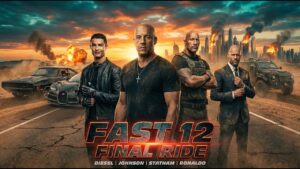
Fast & Furious 12: The Last Ride sounds like a parody when you first hear the premise. A global EMP weapon. Football legends turned tactical operatives. Nitro-powered hypercars flying between skyscrapers. And yet, against every expectation, this film understands exactly what modern blockbuster cinema has become: bigger, louder, more emotional, and completely unafraid of its own absurdity.
And honestly?
That’s why it works.
What This Film Is Really About
Underneath the roaring engines and impossible physics, Fast & Furious 12 is obsessed with one thing: legacy.
Not speed.
Not action.
Legacy.
Dom Toretto has spent over two decades preaching the gospel of “family,” but this time the movie finally asks a painful question: What happens when family becomes mythology?
The plot is gloriously over-the-top. A shadow syndicate gains control of a satellite-based EMP capable of shutting down entire nations. Traditional warfare becomes useless. Governments collapse into panic. Cities go dark.
So Dom does what only Dom Toretto would do.
He recruits football icons Cristiano Ronaldo and Lionel Messi into a globe-spanning mission involving underground races, cyber warfare, tactical infiltration, and enough horsepower to melt asphalt.
Ridiculous?
Absolutely.
But the film leans into its madness with complete sincerity. That sincerity becomes its secret weapon.
There’s a surprising emotional undercurrent running beneath all the spectacle. The screenplay repeatedly contrasts aging legends with younger chaos, asking whether icons can survive in a world addicted to escalation.

“On this track, there are no rivals—only family.”
It’s cheesy. It’s excessive. And somehow, in the final act, it lands harder than expected.
Performance & Characters
Vin Diesel Knows Exactly What Movie He’s In
Vin Diesel no longer plays Dom Toretto like a man. He plays him like folklore.
Every line is delivered with the weight of prophecy. Every stare feels carved from stone. There’s a self-awareness to his performance now that borders on performance art.
And strangely enough, it gives the movie emotional gravity.
Michelle Rodriguez remains the franchise’s most consistently compelling presence. Her Tokyo drift sequence — dodging collapsing shipping containers while neon lights explode around her — is one of the film’s standout moments because it combines chaos with genuine tension.
Cristiano Ronaldo and Lionel Messi Are the Wildcards
This is the part nobody expected to work.
But it does.
Cristiano Ronaldo plays his role with sleek confidence, essentially transforming himself into an international action star. His high-speed delivery mission through Madrid feels like a fusion of football precision and spy-thriller intensity.
Messi, meanwhile, is used far more intelligently than expected. Instead of trying to force charisma, the film turns him into a quiet tactical ghost moving through laser-filled security systems with near-supernatural calm.
The contrast between Ronaldo’s explosive energy and Messi’s silence creates surprisingly effective tension.
It almost fails… but then it surprises you.
Visuals, Tone, and Direction
Fast & Furious 12 understands modern blockbuster imagery better than most superhero films.
The visuals are absurdly ambitious.
- Cars leap between Dubai skyscrapers.
- Gold-plated helicopters tear through sandstorms.
- EMP blackouts plunge entire cities into chaos.
- Salt flats become gladiator arenas for machines and legends.
But what elevates the direction is scale management. Director and cinematography teams know when to go massive — and when to suddenly go quiet.
The film’s best sequence isn’t an explosion.
It’s silence.
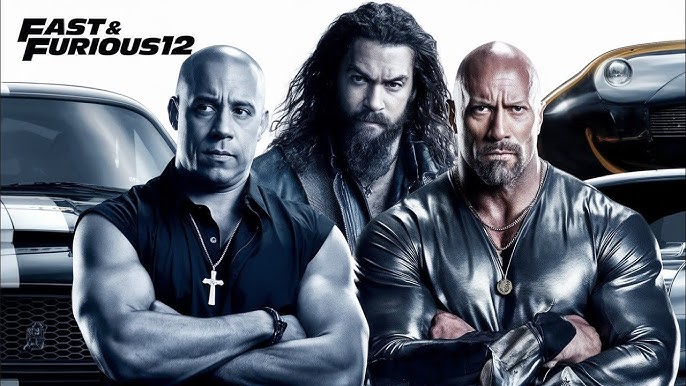
Dom standing between Ronaldo and Messi on an endless white salt flat as engines rumble in the distance feels strangely mythic, almost biblical. The scene pauses long enough for the audience to absorb the insanity of what they’re witnessing.
And then the engines scream back to life.
The tonal balancing act is fascinating. The movie swings wildly between emotional melodrama, meme-worthy absurdity, sports mythology, and pure action spectacle.
Yet somehow it never fully collapses under its own weight.

What Works — And What Doesn’t
What Works
- The action is genuinely creative again. The franchise finally escapes repetition by embracing total cinematic madness.
- The crossover gimmick actually has emotional payoff. Ronaldo and Messi aren’t just cameos — they become symbols of global legacy.
- The pacing rarely slows down. Every sequence feels designed for maximum audience reaction.
- The final act is pure blockbuster adrenaline.
What Doesn’t
- The dialogue occasionally collapses into self-parody.
- Some emotional beats feel engineered for viral clips rather than storytelling.
- The laws of physics officially no longer exist in this universe.
But honestly?
Complaining about realism in Fast & Furious 12 feels like criticizing fireworks for being loud.
Final Verdict
Fast & Furious 12: The Last Ride is not trying to be grounded cinema.
It’s trying to be mythology for the social media generation.
And in many ways, it succeeds spectacularly.
This movie understands that modern audiences no longer just want spectacle — they want moments. Images. Reactions. Emotional insanity they can feel collectively in a crowded theater.
That’s exactly what this delivers.
The most shocking part?
Beneath the outrageous crossover stunt casting and impossible action scenes lies a strangely sincere film about aging legends refusing to disappear quietly.
It’s chaotic.
It’s ridiculous.
It’s emotionally manipulative.
And it might become one of the franchise’s most unforgettable entries.
Final Rating: 8.5/10
Fast & Furious 12 doesn’t just hit the gas pedal — it drives straight into blockbuster immortality.