Most creature sequels get louder, bigger, and dumber.
Crawl 2: A New Level of Terror does something far more dangerous: it gets smarter.

What begins as another flood survival thriller quickly mutates into a suffocating descent into primal fear, where every shadow beneath the water feels alive, every breath feels borrowed, and survival itself becomes a moral compromise. This isn’t just a movie about escaping predators. It’s about realizing you were never at the top of the food chain to begin with.
And honestly?
That realization hits harder than any jump scare.
What This Film Is Really About
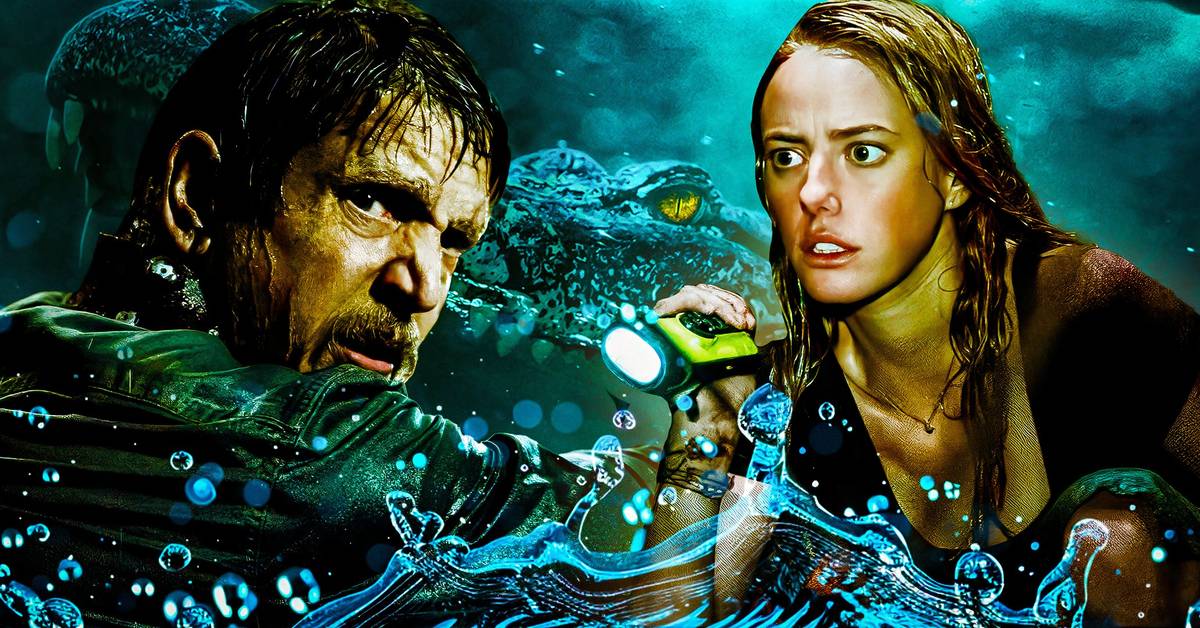
On the surface, Crawl 2 looks like a straightforward disaster thriller: a monstrous storm system floods entire towns, survivors become trapped in submerged buildings, and deadly predators begin hunting through the rising waters.
But beneath the chaos lies something more unsettling.
The film is obsessed with helplessness.
Not cinematic helplessness — human helplessness.
The kind that strips away ego, strength, and certainty until all that remains is instinct.
The screenplay cleverly transforms the flood into more than environmental destruction. The storm behaves almost like a living entity, swallowing roads, isolating families, and reshaping familiar spaces into aquatic labyrinths where danger can emerge from any direction.
There’s a haunting idea running underneath every scene:

Nature doesn’t hate us. It simply no longer notices us.
That emotional undercurrent gives the film weight far beyond its genre.
Performance & Characters
Kaya Scodelario Carries the Emotional Core

Kaya Scodelario delivers a performance that feels bruised, exhausted, and painfully human. Her character isn’t just battling creatures this time — she’s battling memory, trauma, and the psychological scars left behind by surviving the previous nightmare.
You can see it in her hesitation.
In the panic behind her silence.
In the way every decision feels like someone trying desperately not to relive the past.
That emotional realism anchors the film when everything else descends into chaos.
Jason Statham Brings Pure Predator Energy

Then the movie detonates with the arrival of Jason Statham.
It sounds ridiculous on paper.
It absolutely works on screen.
Statham injects the film with a brutal physical intensity that completely changes its rhythm. He doesn’t merely react to danger — he attacks it, challenges it, and sometimes makes it angrier.
The contrast between Scodelario’s emotional survivalism and Statham’s aggressive defiance creates fascinating tension throughout the film.
One fights to endure.
The other fights because refusing to fight feels worse than death.

Visuals, Tone, and Direction
This is where Crawl 2 separates itself from disposable studio thrillers.
The direction understands that terror thrives in limitation.
Flooded hallways become graveyards of uncertainty. Narrow underwater passages feel impossibly endless. Dim lighting obscures movement just enough to let the audience’s imagination become complicit in the horror.
And the cinematography is stunningly cruel.
Reflections distort reality. Murky water hides scale and distance. Tiny ripples suddenly feel catastrophic.
You spend half the film scanning the darkness for movement.
The other half praying you imagined it.
![CRAWL - Kaya Scodelario & Barry Pepper on the Crawl Space [Exclusive Special Feature]](https://i.ytimg.com/vi/ykXj7hOXA40/hq720.jpg?sqp=-oaymwEhCK4FEIIDSFryq4qpAxMIARUAAAAAGAElAADIQj0AgKJD&rs=AOn4CLBjZVMsRfRAzYAW5e8OlOVG-LF3EQ)
The Sound Design Is Weaponized Anxiety
The sound work deserves enormous credit.
The distant groan of collapsing structures.
The deafening silence beneath the water.
The sudden eruption of violent movement.
Every sound feels engineered to tighten your chest.
And when the predators attack, the chaos feels genuinely shocking because the film earns those moments instead of relying on cheap noise.
What Works — And What Doesn’t
What Works
- Relentless tension: The pacing rarely allows emotional comfort, creating a suffocating atmosphere that mirrors the characters’ desperation.
- Smart escalation: The sequel expands the scale without losing the claustrophobic terror that made the original effective.
- Emotion beneath the horror: Themes of grief, survival guilt, sacrifice, and fear of loss give the story unexpected depth.
- Visceral action sequences: Several underwater chase scenes are genuinely nerve-shredding.
- Excellent creature staging: The film understands the power of partial visibility. What you barely see becomes unforgettable.
What Doesn’t
- A few familiar disaster-movie clichés: Certain side characters exist mainly to make terrible decisions.
- Occasional tonal excess: Some late-action sequences flirt with becoming too bombastic compared to the grounded horror earlier on.
- Thin supporting cast: Outside the two leads, several characters feel more functional than memorable.
Still, the film almost fails precisely because it reaches so aggressively.
But then it surprises you.
Again and again.
Final Verdict
Crawl 2: A New Level of Terror isn’t merely trying to top the original film.
It wants to drown you in it.
What could have been another forgettable creature-feature sequel instead becomes one of the most intense survival thrillers in recent memory — emotionally grounded, visually oppressive, and terrifyingly immersive.
By the final act, the movie evolves into something almost mythic: humanity reduced to instinct against a world that has turned violently indifferent.
And that’s what lingers after the credits roll.
Not the attacks.
Not the blood.
Not even the storm.
It’s the horrifying realization that survival isn’t about escaping monsters.
It’s about discovering how quickly civilization disappears once fear floods the room.
Rating: 4.5/5