What happens when precision becomes personality—and silence becomes power?
HITMAN 2 doesn’t just pull the trigger. It studies the moment before it.
And then… it dares you to look away.
What This Film Is Really About
Strip away the contracts, the disguises, the globe-trotting spectacle—and HITMAN 2 reveals itself as something colder, sharper, and far more unsettling.
This isn’t just a film about killing.
It’s about control.
At its core, the story follows an elite assassin navigating a web of high-profile targets, shadow networks, and moral ambiguity. But beneath the polished executions lies a deeper tension: the erosion of identity in a life dictated by precision and anonymity.
The world of HITMAN 2 is sleek, yes—but it’s also suffocating. Every location, from opulent galas to sterile corridors, feels like a stage built for death. And every mission is less about survival… and more about perfection.

Performance & Characters
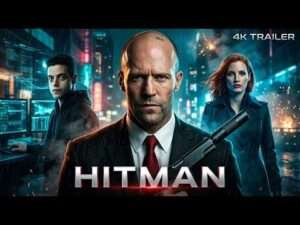
Jason Statham as Agent 47 is the film’s most daring—and divisive—choice.
And somehow, it works.
He doesn’t mimic the video game icon. He reinterprets him. His version of 47 is less robotic, more controlled menace—like a man who’s learned to suppress emotion so completely that even a glance feels dangerous.
He doesn’t dominate scenes. He erases them.

Key Dynamics
- Agent 47: Calculated, efficient, and eerily calm—his silence speaks louder than most action heroes’ monologues.
- The Targets: Not caricatures, but carefully constructed figures of power—each assassination feels earned, not random.
- The World Around Him: Suspicious, layered, and constantly shifting—forcing 47 to adapt or vanish.
There’s minimal dialogue—but maximum tension.
And that restraint? It’s exactly what gives the film its edge.

Visuals, Tone, and Direction
This is where HITMAN 2 truly locks in.
The direction leans heavily into clean geometry, sharp framing, and deliberate pacing. Every shot feels like it’s been measured with a ruler—and executed with surgical intent.
No shaky cam. No chaotic editing.
Just clarity.
The film’s most talked-about sequence—a high-security luxury gala hit—is a masterclass in visual storytelling. Disguises, movement, timing… everything unfolds like a silent symphony of death.
It’s not loud.
It’s lethal.
The color palette stays grounded: muted blacks, sterile whites, and flashes of gold that remind you of the wealth—and corruption—behind every target.

What Works — And What Doesn’t
What Works
- Precision-driven action — Every kill has purpose, setup, and payoff.
- Stylish minimalism — The film trusts silence more than spectacle.
- Memorable set pieces — Especially the gala climax, which feels both elegant and terrifying.
What Doesn’t
- Emotional distance — Some viewers may struggle to connect with such a detached protagonist.
- Comparison to the games — Fans of the source material may find it less sandbox, more scripted.
- Pacing dips — A few transitions between missions feel slightly undercooked.
It almost becomes too controlled…
But then it surprises you.

Final Verdict
HITMAN 2 isn’t trying to be loud, explosive, or universally crowd-pleasing.
It’s trying to be exact.
And in that pursuit, it becomes something rare in modern action cinema: a film that values patience over chaos, intention over noise.
“Perfection isn’t dramatic—it’s inevitable.”
That’s the philosophy pulsing beneath every frame.
Is it better than the games?
That depends on what you’re looking for.
But as a cinematic experience?
It hits its mark.
Final Score: 7.8/10
No witnesses.
Just impact.